Lessons from Theatre 4: Dr Luke Fourie's Speech Night Address
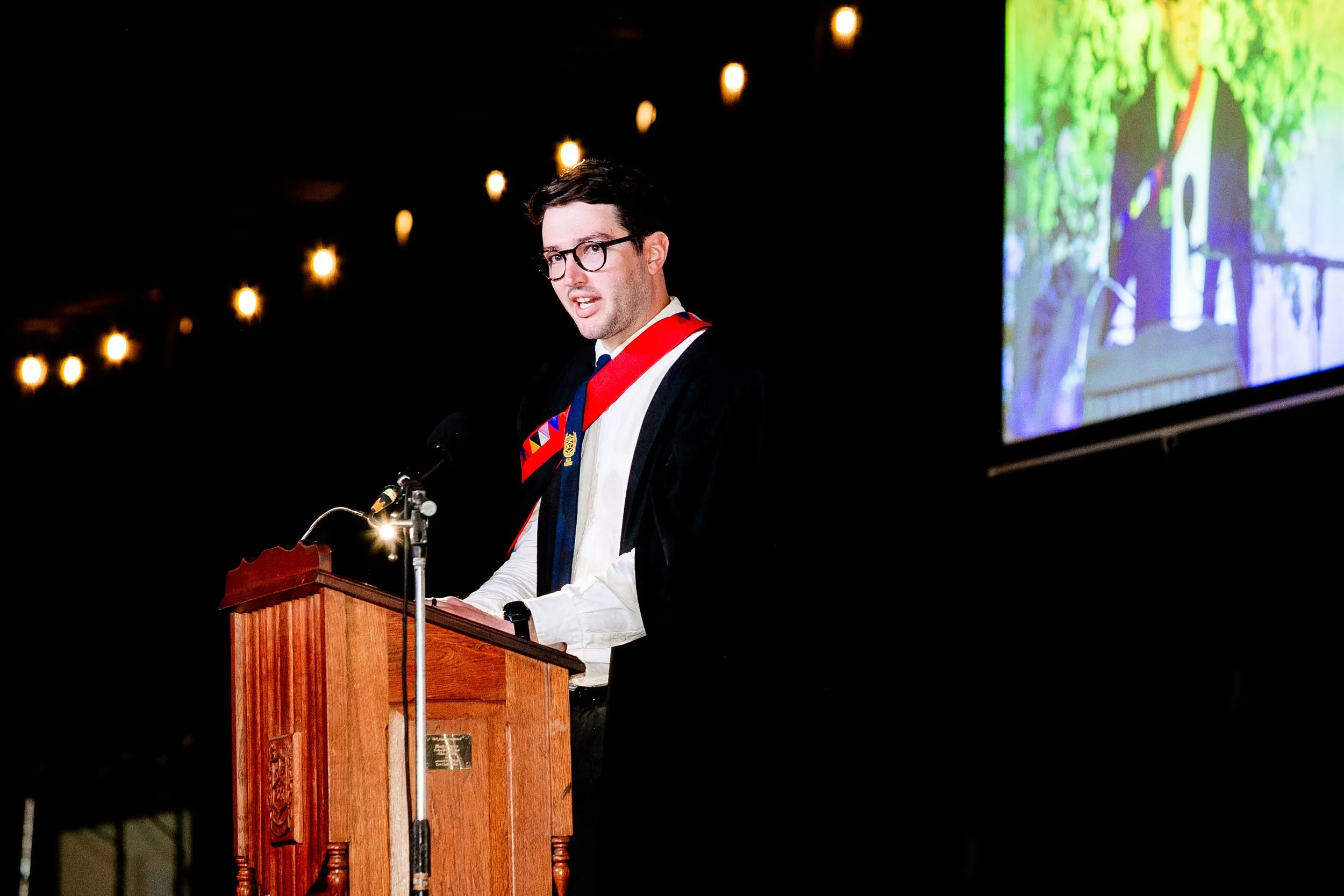
At this year's Speech Night, we were honoured to welcome Old Boy Dr Luke Fourie as our guest speaker. Now a surgeon, Dr Fourie took us into "Theatre 4" and drew on what he has learnt there to speak about life, courage and the value of doing hard things.
His address was thoughtful, honest and full of lessons that our boys, and the rest of us, can carry well beyond the school gates. We're delighted to share his speech in full below.
Good evening, ladies and gentlemen, distinguished guests, and most importantly, boys of St Charles College. It is a privilege to be asked to come back to speak, and I would like to thank Mr van Blerk, Mr Holcomb, and the rest of the SCC staff for the opportunity to be here tonight. It doesn’t feel like 13 years have passed since I was last on this stage, and I am happy to see some familiar, gracefully aged, handsomely balding faces still sitting here to my left. Thank you to the boys and your parents for having me. It is because of you that this institution can continue producing conscientious men of integrity and ambition. Lastly, thank you to my parents for realizing that SCC would be a good fit for me, and to my wife for standing by my side through thick and thin.
When thinking of a topic for this talk, many topics came to mind. I have been fortunate to have been preceded on this stage by close mentors who turned into friends after school, the likes of Charles Malanga and Michael Day. After speaking with them, I realized I needed to speak about something that I can personally vouch for and have experienced myself. Please do not be disheartened by what I'm about to say but rather use it as encouragement to tackle difficult times head-on, knowing that this school has equipped you with all the tools necessary for victory.
Now, as the matric boys sitting here, not all of you will have such a long, protracted journey to get to your end goal, but hopefully you will think back to tonight and remember some of what I have shared with you. I am not that different from many of you sitting here, and you will be faced with a lot of the same challenges I encountered. I am not talking about how you will get home from the club at 3 am, or how you are going to budget your remaining R150 for the last 2 weeks of the month. I am talking about when you realize you are now an adult and must take full responsibility for your actions; I am talking about when you realize you are completely alone and there is no one except you to sort out whatever you are going through. This is when your real mettle is tested, and the buck stops with you. I have titled my speech “Lessons from Theatre 4” because that’s the name of the theatre I have predominantly operated in for the last 5 years, and I have learnt the most lessons in. Tonight I hope to share some of those lessons with you- lessons I have had to learn firsthand through my experiences with patients and fellow doctors- but they are hopefully applicable to everyday life situations.
Lesson 1: The Bleeder
There is a very specific sound the anesthetic machine makes when a patient’s blood pressure is dropping. Normally, theatre 4 has a steady, predictable rhythm. You have your scrub nurse handing you instruments; there is the monotonous hum of the theatre aircon and the slow rhythmic beep, beep, beep coming from the heart monitor. It's controlled. You are following the plan. Until, suddenly, you aren’t.
Maybe it’s a complex case or maybe a tiny, millimeter-wide metal clip slips off an artery. In a fraction of a second, the surgical field fills with dark red blood. You cannot see the anatomy anymore; the suction machine is gurgling, and that slow, steady beep from the monitor instantly accelerates into a high-pitched, frantic alarm. In that moment, the tension in theatre 4 is suffocating.
Your biological instinct in that exact moment is to panic. Your own heart rate spikes, your brain screams at you to freeze, and you might even start blindly trying to clamp the bleeding vessel, which can cause catastrophic damage.
But you don’t do that. You do what you are trained to do. You take a breath, ask the sister to hand you a swab, place it over the bleeder, and hold firm and steady pressure. You stop the chaos and buy yourself time and methodically find the source of the problem and fix it.
You are all soon stepping into a world that is going to ask you to do hard things, and I can guarantee that you will encounter your own bleeders. You are going to hit moments where the plan falls apart. You may fail an exam you studied for months, a career plan may shatter, or a personal crisis may hit you out of nowhere, and the alarms in your head will start ringing.
When this happens, I want you to remember Theatre 4. Do not freeze; do not thrash around blindly, making it worse. Take a breath, apply pressure, stop the immediate bleeding, figure out exactly where it’s coming from, and correct the source. Doing hard things doesn’t mean that everything goes perfectly; it means you learn how to manage the chaos when it doesn’t.
Lesson 2: The Deep Pelvis
The truth about doing hard things is that it isn’t always about adrenaline and alarms. It is, in fact, most of the time, a quiet and exhausting grind.
In general surgery, one of the most demanding spaces to operate in is the pelvis, often during a resection for something like rectal cancer.
When the surgery starts, everyone is fresh. There’s a lot of energy in the room. But if you fast-forward four or five hours, the initial excitement is long gone; you are operating in a dark, narrow, and unforgiving space, and the anatomical margins you are working with are millimeters small. Your neck is cramped, your back is aching, and you are physically and mentally drained.
Another analogy is being 60km deep into a 100km mountain run. The starting line cheer is a distant memory, the finish line is nowhere in sight, and all you are left with is the grueling, uncomfortable middle.
To the matric boys, many of you are in the middle right now. You are grinding through a long academic year. You are staring down massive exams, trying to build a future, or maybe just trying to figure out what kind of man you want to be. And I am sure many of you have realized that the “middle” is not glamorous. No one is clapping for you when you are at your desk studying at 11 pm on a Tuesday.
Thankfully, theatre 4 has taught me that the middle is usually where victory is secured. You do not get a successful surgical outcome because you had a great first 10 minutes. You get it because you refused to lose focus at hour 4 when your back is screaming at you to rush and just get the case done.
Doing hard things means respecting the process, even when you are exhausted. It means maintaining your standards of excellence when no one is watching, when the adrenaline is gone, and when it’s just you and the work. You do not have to be the loudest or the fastest; you just must be the one who refuses to compromise when it gets uncomfortable.
Lesson 3: Holding the Retractor
When you first start training to be a surgeon, you have all this ambition; you have studied for years, you finally walk into Theatre 4, and you think you are ready to save lives.
The crushing reality is that when you start, you get handed a heavy metal retractor; they tell you to hook it under the muscle, pull back as hard as you can, and absolutely do not move. For three hours. Your arms shake; your fingers go numb. It is boring, painful, and it feels entirely beneath you. You want to be holding the scalpel, but instead you are essentially a human doorstop.
The lesson here that every young surgeon needs to learn, and I believe every young man needs to hear you have to earn the right to hold the scalpel.
We are living in a world that constantly tells you that you deserve the spotlight right now. But doing hard things requires profound humility. It requires a willingness to do the boring, unglamorous, repetitive tasks perfectly.
If you cannot be trusted to hold the retractor when your arms are shaking, you will never be trusted to make the incision. Whatever you do next year, whether you go to university, start a trade, or enter the workforce – do not walk in demanding the scalpel. Walk in, grab the retractor, and outwork everyone in the room until they have no choice but to hand you the scalpel.
Lesson 4: The Scrub Sister
There is a famous stereotype that surgeons are arrogant, caffeine-fueled control freaks who view human anatomy as a plumbing problem. We walk into the theatre, demand a scalpel, and single-handedly conquer the disease.
But this is mostly a lie.
If you want to know who runs Theatre 4, it is not the surgeon, but rather the veteran scrub nurse standing across the table. She has been doing this for twenty years, has seen many surgeons come and go, and is the cornerstone of patient care in the theatre. If I get arrogant and stop communicating with her, the surgery grinds to a halt. But if I trust her, she places the exact instrument I need into my hand, two seconds before I even know I need it. Meanwhile, the anesthetist at the head of the bed is quietly keeping the patient alive while I work. I might be the one cutting, but I am completely dependent on the people around me.
Men, as you go out into the world to do hard things, kill the idea that you have to do it alone. There is a toxic myth that asking for help is a sign of weakness. In Theatre 4, if you are in trouble and you don’t call for help, people die.
Look around this hall tonight: your teachers and your parents are your anesthetists and scrub nurses. They have been handing you the tools you need long before you even knew you needed them. Doing hard things doesn’t mean being a lone hero. It means being smart enough to rely on the crew standing around your table.
Lesson 5: The Anesthetist
Just a quick disclaimer, as I know a few anesthetists are sitting here tonight; some of my best friends are anesthetists, and I do love them dearly. We just sometimes have differing perspectives about what’s going on in theatre.
Picture this: I am 4 hours into a case, sweating under the hot theatre lights and my feet are throbbing; hyper-focused on dissecting out a very difficult and very stubborn piece of anatomy.
Then, I glance over the sterile drape to the head of the bed where the anesthetist sits. He or she is sitting on a padded, most likely ergonomic, chair, sipping their coffee from a flask and scrolling Instagram or TikTok. They don’t ask you how you are feeling; they will just stare at you blankly and then discerningly at the suction bottle to see if I have bled their patient out. The urge to throw an instrument at them is almost overwhelming.
The lesson: you cannot operate while looking over the drape.
In high school and in life, you are going to be sweating through some incredibly difficult situations – whether it be studying for a subject you hate, trying to make a team, or just figuring out your life – and you are going to look over and see someone else seemingly breezing through it with a coffee in hand. It will drive you crazy.
Do not get distracted by someone else’s easy time. You have no idea what their job requires, and staring at them enviously won’t make your surgery go any faster. Stay in your lane, keep your eyes on your own field, and do your own work.
Lesson 6: The Tea Room
There is an ancient, unwritten code among doctors, passed down from generation to generation, that is vital for survival.
The rule: Never stand when you can sit. Never stay awake when you can sleep, and you never leave the tearoom without getting something to eat or drink, because you can never be sure when you’ll next get a chance to go back.
When you start working in theatre 4, you think you are an absolute machine. You think you can operate for ten hours straight on nothing but adrenaline, Red Bull, and sheer willpower. The reality is you cannot. By hour seven, your hands will start to shake, your brain will get foggy, and you will start to make very stupid decisions.
The most important area in a hospital for a doctor is not the theatre or pharmacy, but the tearoom.
A lot of young men treat sleep deprivation and terrible diets like a badge of honor. You brag to each other about pulling all-nighters to study or surviving a weekend on nothing but energy drinks and vibes. This is not a badge of honor; it is just bad planning.
You cannot do hard things if your battery is completely dead. Your brain and your body are the same as the patient on the table – if you don’t give them oxygen and fuel, things start shutting down. So go to sleep. Eat a vegetable occasionally. Take care of the machine, because you are going to need it to run for a very long time.
In closing, I have one final message for you. When I take my scrubs off and walk out of the hospital, the lessons from Theatre 4 come with me. I carry them when I am out in the mountains, hours deep into a trail run when my legs are burning, and I want to quit.
But more importantly, I carry them home.
Looking out at all you young men tonight, my perspective is a little different than it was 13 years ago. I have a young son of my own right now, and I know that it will be a blink of an eye before he is going to be sitting in a hall exactly like this, wearing a blazer and staring down the rest of his life.
When I think about the man I want him to become, I don’t hope that he has an easy life. An easy life doesn’t build a resilient man.
I hope he faces challenges. I hope he learns what to do when his plans are bleeding, and the alarms go off. I hope he learns how to grind through the exhausting, unglamorous middle of the goals he sets for himself. I hope he has the humility to hold the retractor when it’s required, and the wisdom to know that he doesn’t have to do any of it alone.
The world outside these doors is not going to ask you to be perfect. But it is going to ask you to do hard things. Do not run from them; step up to the table, take a breath, and get to work.
Thank you and goodnight.